100% Local-First · Zero Telemetry · MIT Open Source

The Local-First AI Agent IDE

Autonomous multi-step coding missions that execute directly on your local workstation. Edits files, runs sandboxed terminal processes, and controls browsers without transmitting your project code to cloud servers.

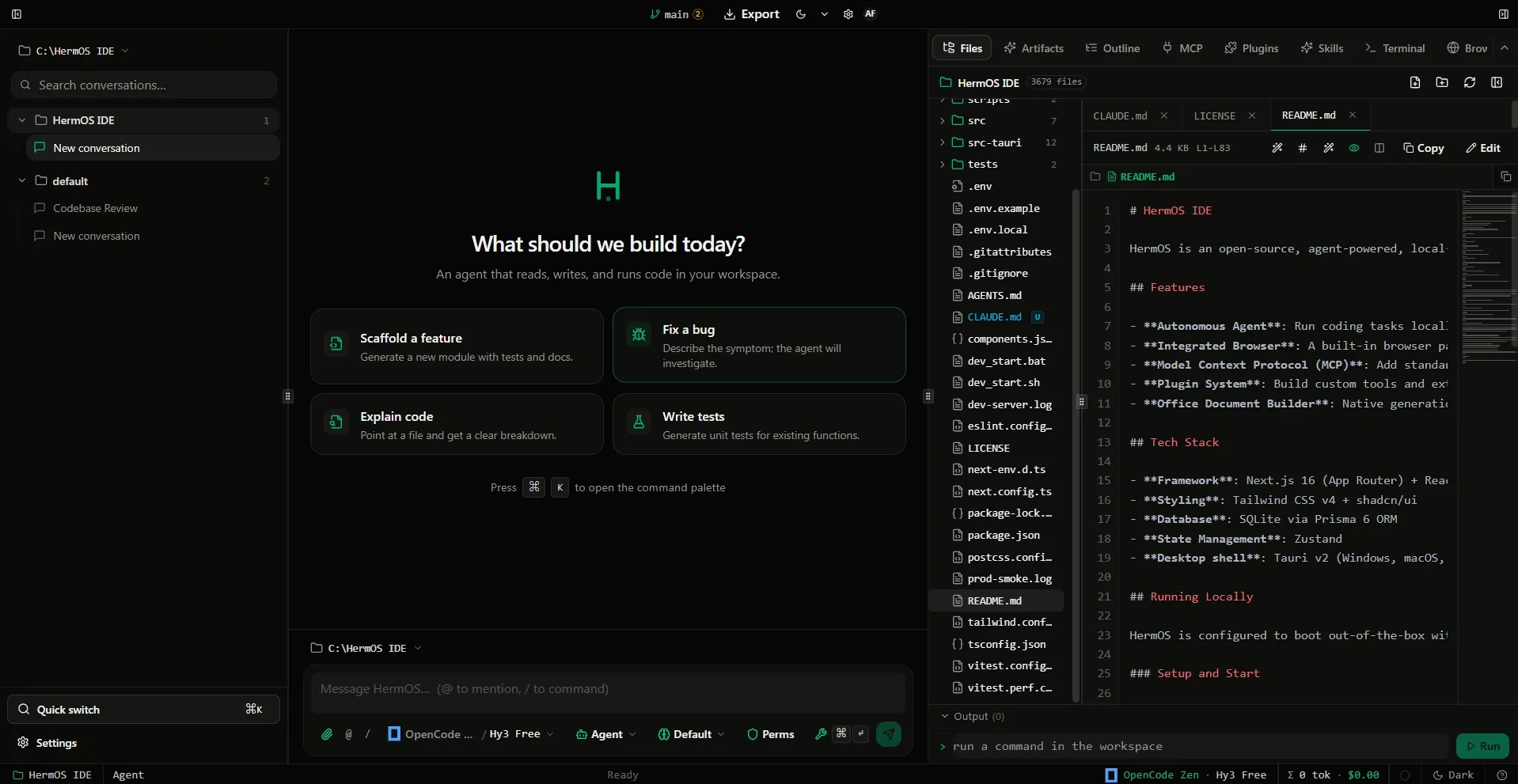
hermos-ide — main workspace & code editor
HermOS Main Workspace Interface
View Full Resolution
Engineered For Autonomy

Autonomous capabilities that run on your machine

Everything runs as native child processes on your workstation with zero telemetry and full sandboxing.

01 / AUTONOMOUS WORKERS

Subagent tree orchestration for parallel missions

When tackling complex refactors or multi-file features, HermOS decomposes the problem and forks background subagents. One agent investigates schemas while another writes unit tests and verifies fixes.

Subagent Trees Independent forks
MCP Tool integration
Headless Browser Live DOM testing
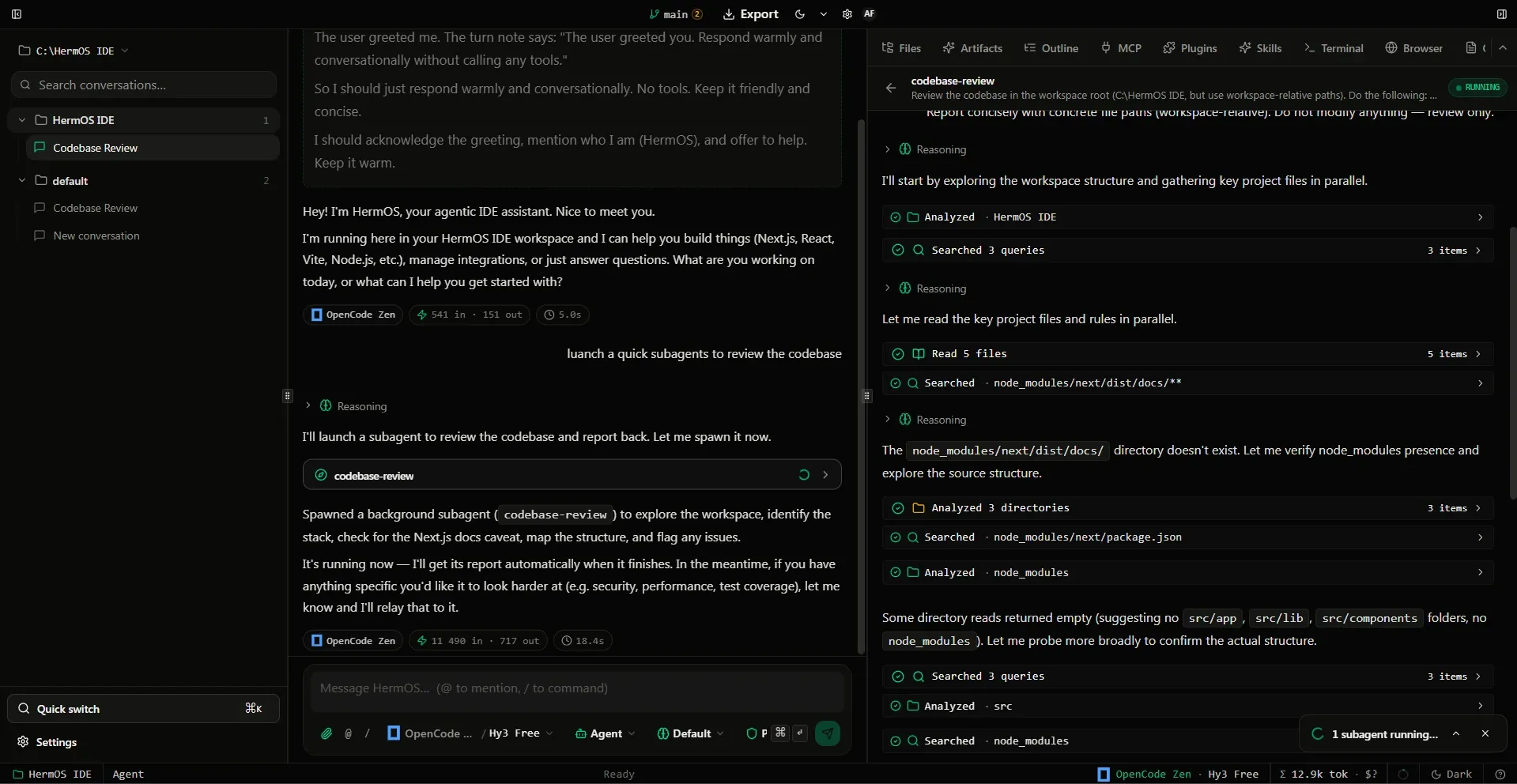
HermOS Autonomous Agent and Subagent reasoning view
02 / LOCAL TELEMETRY

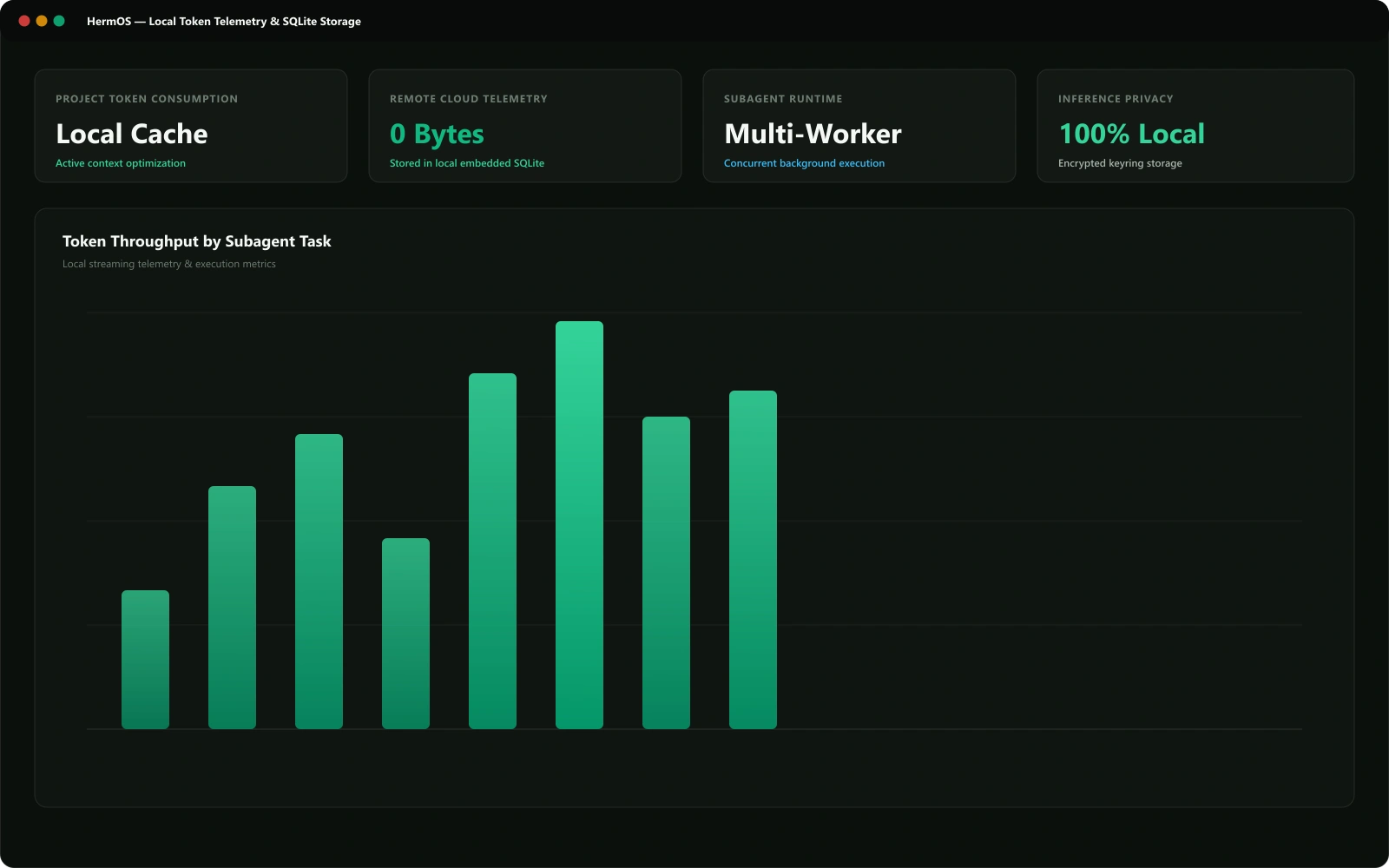
Real-time token analytics stored in local SQLite

Monitor token consumption, prompt cache hit ratios, and model execution latency without a single byte of telemetry leaving your computer. All charts are rendered from your embedded SQLite store.

0 Bytes Cloud Zero telemetry
SQLite Embedded Local analytics
Cache Radar Latency metrics
HermOS Local Token Usage Radar and analytics
03 / ATOMIC CHECKPOINTS

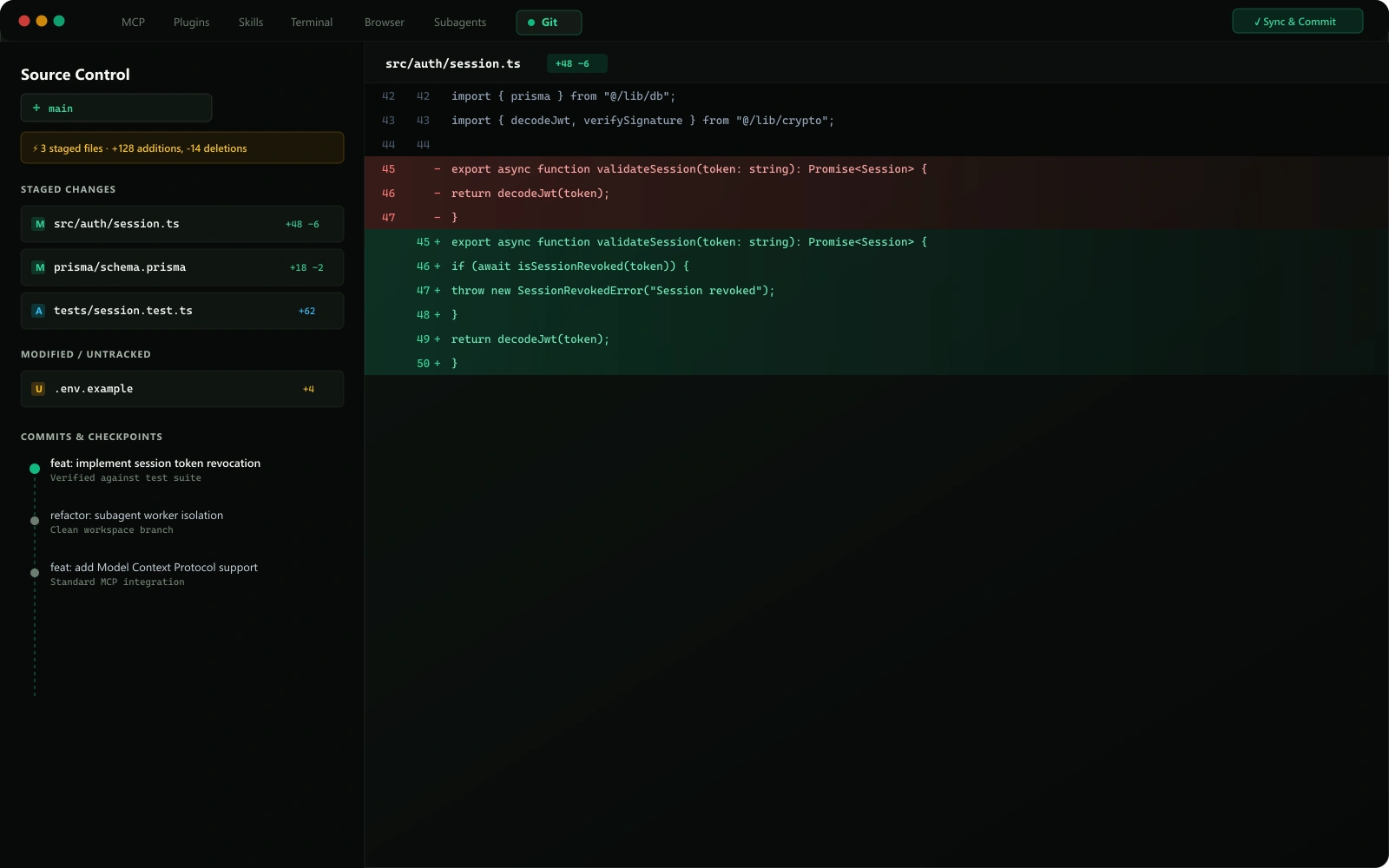
Line-by-line visual diffs with 1-click rollback

Inspect every change proposed by an agent before it commits. Review visual split diffs, staging states, branch trees, and roll back atomic checkpoints seamlessly.

Visual Diffs Syntax highlighted
Checkpoints Instant undo
Native Git Direct repository sync
HermOS Git Diff Panel and branch checkpoint manager
Universal BYOK & Inference Matrix

Connect Any Foundation Model or Local Offline Engine

Zero vendor markup. Bring your own keys or run 100% offline and air-gapped on your local hardware.

Local Offline Inference (Ollama / vLLM / SGLang)

Air-gapped local inference. Zero API costs, zero internet required.

Endpoint: http://127.0.0.1:11434/v1 Zero Cloud Telemetry
Supported Model Architecture
qwen2.5-coder Code AST & Refactoring Specialist
deepseek-r1 Chain-of-Thought Reasoning
llama-3.3 Autonomous Task Planning
Key Security & Privacy

No API key required. HermOS connects directly to localhost port 11434 with zero external telemetry or cloud mediation.

✓ AES-256-GCM Encrypted Local Key Storage
Native Desktop Installers

Download HermOS Free

Runs natively on Windows, macOS, and Linux with no account required.

Windows

Windows 10 / 11 · 64-bit .msi installer

Download for Windows

macOS

Apple Silicon & Intel · universal .dmg

Download for macOS

Linux

Ubuntu / Debian 64-bit · .deb package

Download for Linux
View all release packages (.exe setup, .AppImage, checksums) →
RUN FROM SOURCE (NODE / GIT) DEV SETUP
$git clone https://github.com/WFekik/HermOS-IDE.git && cd HermOS-IDE && npm install && npm run tauri dev
Questions & Answers

Frequently Asked Questions

Everything you need to know about security, API keys, and local execution.

Is HermOS completely free and open source? +
Yes. HermOS is MIT licensed open source software. There are no subscriptions, paywalls, or gated "Pro" tiers. You can read, build, and modify the source code on GitHub.
Does HermOS send any telemetry or project code to a remote server? +
No. HermOS operates with zero telemetry and has no login servers. When you converse with an AI model, queries route directly from your workstation to the configured provider API using your encrypted API key.
Can I use HermOS with local models offline? +
Yes. HermOS connects seamlessly to local inference runtimes including Ollama, vLLM, and LM Studio. When paired with local models, HermOS functions 100% offline with zero internet connectivity.
How are API keys stored on my computer? +
API keys are encrypted with AES-256-GCM and stored locally on your machine — never sent to our servers (there are none). The encryption key is generated per install and never leaves your device.
Where can I get help or report a problem? +
HermOS is developed in the open on GitHub. Bug reports and feature requests go to GitHub Issues, and questions, ideas, or show-and-tell belong in GitHub Discussions.